Vision Correction Surgery (LASIK)
Vision correction surgery (LASIK) is a procedure that addresses vision problems for patients suffering from:
- Nearsightedness (Myopia): The inability to see distant objects clearly.
- Farsightedness (Hyperopia): The inability to see near objects clearly.
Additionally, there are other cases where the doctor determines the need for vision correction surgery and the appropriate method for it.
Vision correction surgery (LASIK) is one of the most famous and common laser surgeries for correcting vision problems. It can be an effective alternative to eyeglasses and contact lenses.
In eyes with normal vision, light bends (refracts) accurately within the cornea onto the retina at the back of the eye. However, with nearsightedness, farsightedness, or astigmatism, light bends incorrectly, leading to blurred vision. It can be an alternative to eyeglasses, but reshaping the cornea itself will provide the necessary light refraction, which improves vision and will free the patient from using eyeglasses or contact lenses.
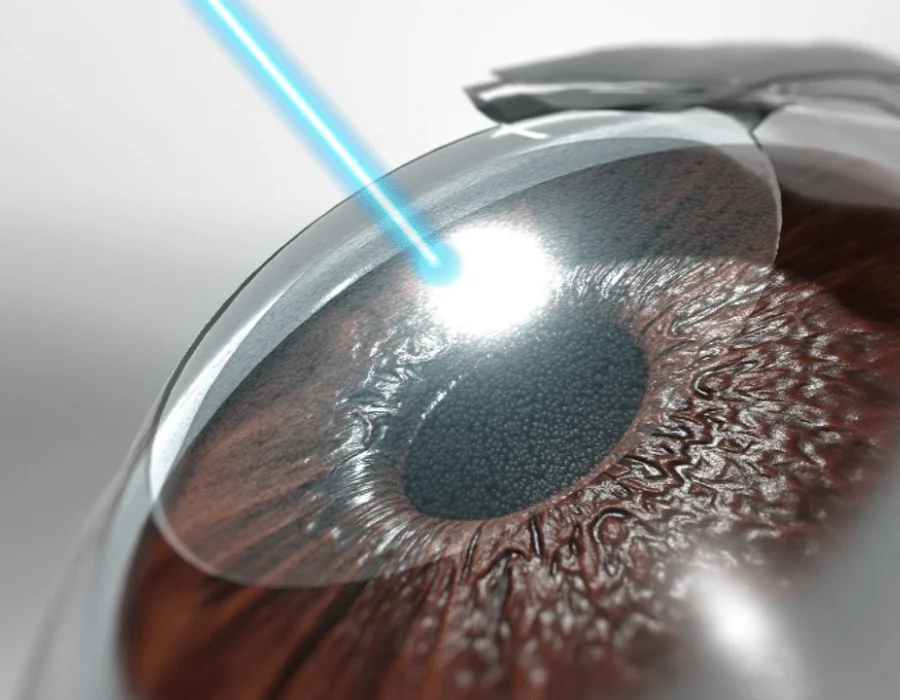
Vision correction surgery (LASIK) is a procedure that aims to modify the shape of the eye's cornea by removing a very thin layer of the cornea while necessarily leaving an attached part. Dr. Amin Faisal replaces the superficial layer of the cornea, which then heals without any surgical intervention. The patient is partially anesthetized during the operation, but anesthetic eye drops are used inside the eye. These procedures are usually safe and effective, but they require a precise and prior evaluation of the patient's condition and expectations.
The procedure typically does not exceed 10 minutes.
There is more than one type of vision correction surgery. Professor Dr. Amin Faisal Ellakwa determines the appropriate procedure or type of surgery after examination and diagnosis, based on corneal topography tests and the eye's condition, following a clinical examination.